9/29/2026
Murata Manufacturing Co., Ltd.
President: Norio Nakajima
Murata Manufacturing Co., Ltd. (hereinafter, "Murata") has developed an AI-driven R&D infrastructure (hereinafter, "the System") that links in-house experimental data, analysis data, proprietary algorithms, and technical knowledge with multiple AI agents. The System autonomously searches and utilizes experimental and analysis data as well as technical knowledge, and provides seamless support for everything from experiment planning to data analysis, report creation, and the accumulation and use of knowledge. Murata will gradually roll out the System, starting from the materials development field, in order to achieve more efficient data-based R&D and create new knowledge.
In materials development for electronic components, a wide range of experimental data is created on a daily basis, including material compositions, manufacturing conditions, analysis results, and characteristic evaluations. These data may be managed using different formats depending on the research theme or department, and the time needed to organize and analyze data, search past experimental results, and make use of knowledge across departments has been an issue. In addition, R&D work has traditionally entailed performing experiments, organizing the data, analyzing it using multiple tools, and then creating reports. For this reason, it took a certain amount of time to decide the next experiment direction based on the experimental results.
Murata handles everything from materials and process development to product design, production technology, analysis, and evaluation, and has as a result accumulated a wide range of experimental data and technical knowledge. To enable use of this data and knowledge across research themes and organizations and to enhance both the speed and quality of R&D, Murata has developed an AI-driven R&D infrastructure that links experimental data with multiple AI agents.
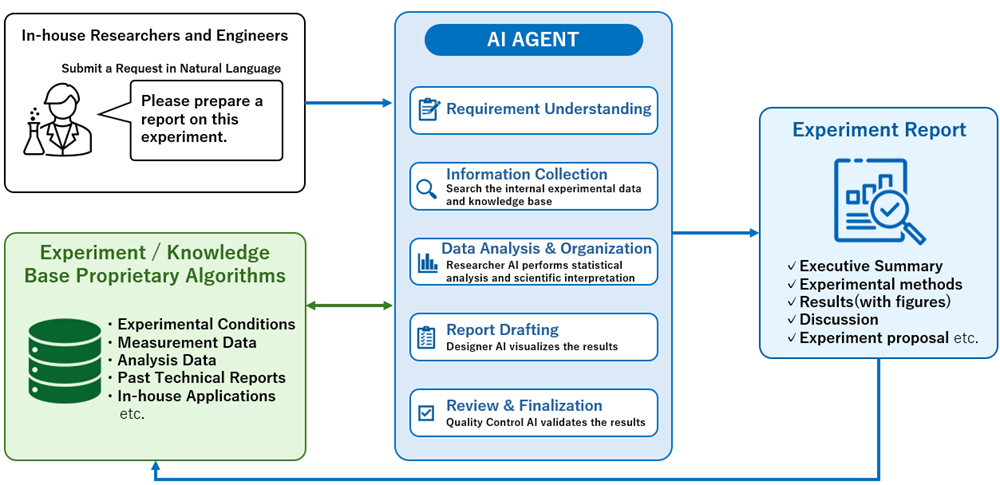
Schematic of the AI-driven R&D infrastructure
The System is an experiment and data analysis environment that links experiment and analysis databases compiled by Murata, proprietary algorithms, and in-house technical knowledge with multiple AI agents. The results of experiments and evaluations conducted by researchers on a daily basis are accumulated in an experiment database, making material compositions, manufacturing conditions, analysis results, characteristic evaluations, and related knowledge usable across teams and organizations. Data and knowledge obtained in the past are centrally managed and seamlessly linked with an analysis environment that makes use of AI and machine learning, making it possible to understand trends in experimental results more efficiently, analyze factors, and explore optimal conditions. Researchers access the System via a web browser and give instructions regarding the analysis content and purpose in natural language. AI agents read the instructions and autonomously perform tasks such as browsing experimental data, formulating analysis plans, generating and executing code for analysis, visualizing data, drafting proposals for consideration, and creating reports. In addition, by assigning an AI agent to each role, such as data analysis, scientific consideration, and report generation, and then linking these multiple agents, the series of operations can be executed while leveraging the specialization of each agent. Researchers then utilize their own specialized knowledge to check the content of the AI-generated analysis results and considerations and make the final decision. This achieves both efficient processing using AI and human-based verification of scientific validity.
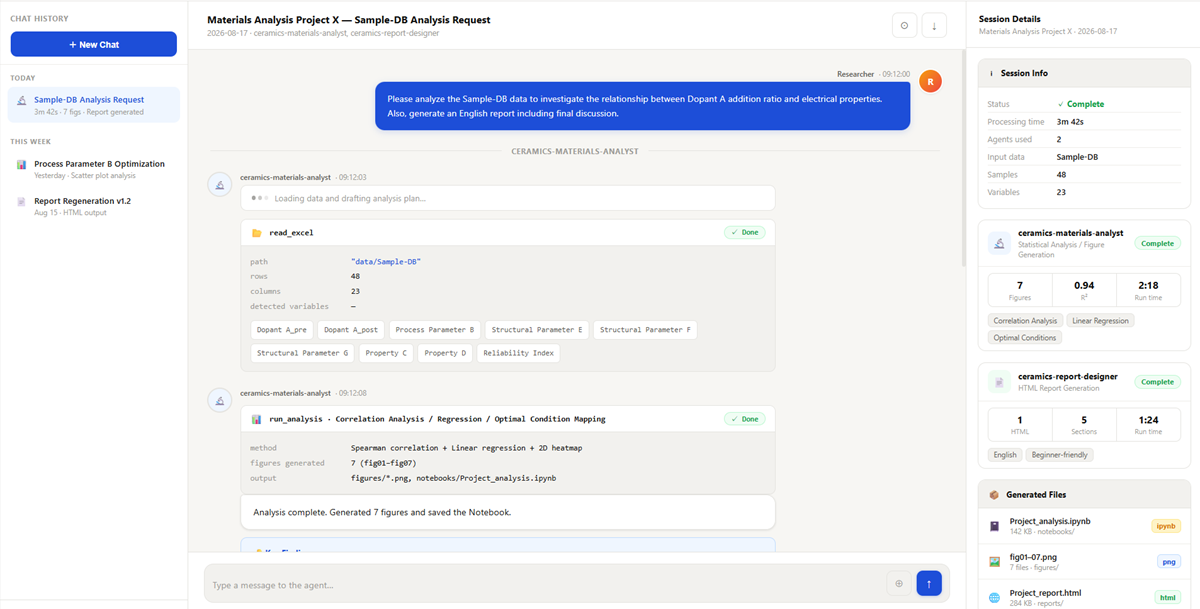
Image of the development environment UI and input/output
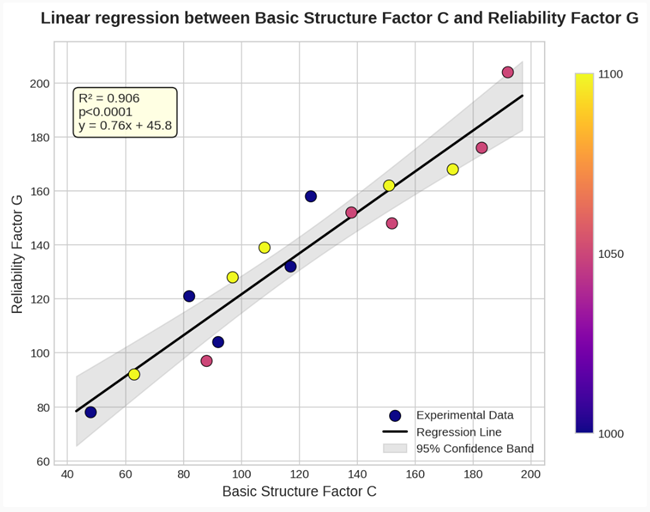
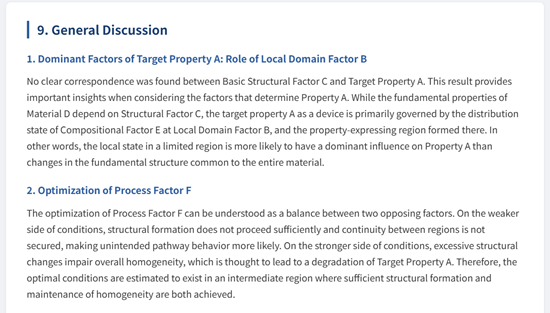
Image of analysis data visualization and reporting*
* This consideration shows an example of analytical output by AI. From the perspective of protecting technical information, proper names such as target materials and process conditions have been replaced with symbols (A to G) to present the data in an abstract form.
In-house demonstrations assuming materials development work have confirmed that the entire series of processes can be executed, from loading data such as material compositions, experiment conditions, analysis values, and electrical characteristics into the System, analyzing correlations between data, visualizing results using tools such as heat maps, preparing draft scientific considerations, generating reports, and proposing conditions for the next experiment. In some cases, the process from loading data to analysis, creation of tables and diagrams, and report generation was executed in about 10 minutes.*1 Furthermore, in simulations based on a work model set by Murata, the number of processes per unit time for the three processes of experiment planning, data analysis, and report generation was estimated to be around 22.5 times that of the traditional workflow.*2
Murata is also promoting a cross-organizational initiative led by a special team to widely spread the use of data science, including the System, to R&D sites. Through this initiative, R&D organizations work closely together to promote data science education, the establishment of environments for data use, and in-house awareness-raising activities in an integrated manner. The special team helps to introduce the System after understanding the challenges and work processes at each development site to help accelerate the creation of a system that lets each development team use data on their own to analyze experimental results, improve quality, and optimize development conditions.
| Process |
Previously |
Using the System
|
Experiment planning based on design of experiment (DOE)
|
Approx. 1 hour
|
Approx. 10 minutes
|
Data analysis
|
Approx. 6 hours
|
Approx. 20 minutes
|
Report creation
|
Approx. 8 hours
|
Approx. 10 minutes
|
*1 Result demonstrated by Murata using verification data. Processing times will vary depending on factors such as data volume, analysis content, and usage environment.
*2 In-house estimate based on simulations, and not a guarantee of actual effect.
Murata has positioned the DX promotion set out in our Vision 2030 and Medium-Term Direction 2027 as an important business transformation that will directly boost the value of our organizational and human capital. Going forward, we will combine our original materials, processes, and analysis and evaluation technologies with AI to transform the R&D process and accelerate the creation of new products and technologies.
Murata in Brief
Murata Manufacturing Co., Ltd. is a worldwide leader in the design, manufacture and sale of ceramic-based passive electronic components & solutions, communication modules and power supply modules. Murata is committed to the development of advanced electronic materials and leading edge, multi-functional, high-density modules. The company has employees and manufacturing facilities throughout the world.
For more information, visit Murata's website